

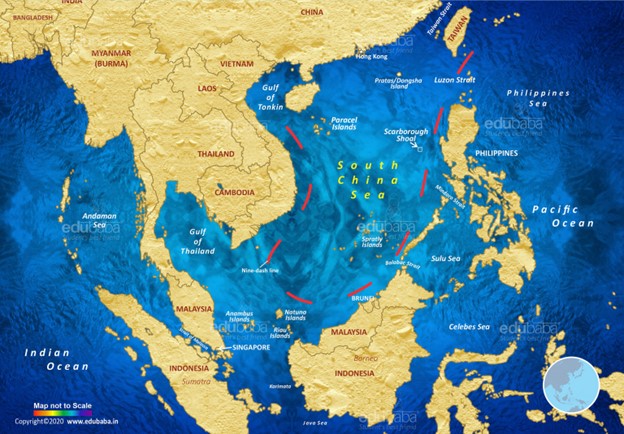
The best evidence of China's expansionist agenda is its recently released administrative map, the so called 10 dash line which encompasses a wider and larger area than that within the previous 9dash line, a claim ruled by the 2016 Hague Arbitral Tribunal as without historical and legal basis under UNCLOS. China states that military alliances and blocks being led and formed by U.S. among Asian states aim to contain China. The use of the word 'contains' reveals China hegemonic designs. So said DND Sec Guillermo Teodoro in response to questions about these issues. What is the guiding doctrine of China's expansionist drive?
Former U.S. Secretary of State Henry Kissenger in his book 'China' wrote that Chinese leaders and strategists follow an ancient board game called WEI QI which stresses encirclement rather than domination and value strategic envelopment than destructive confrontations. (Kissenger was President Richard Nixon's emissary to China that led to the withdrawal of U.S troops from the disastrous Vietnam war from 1969-77 that killed 40,000 Americans, its termination and the reopening in 1977 of diplomatic ties between U.S. and China (U.S. and China were allies in WW ll 1941-1945 against Japan, now a close and strong ally of U.S. against China. So, with Philippines which fought Japan in same war, now her biggest donor, aider, investor and a strong defense supporter. (How true what Prime Minister Vincent Palmestron of United Kingdom said in 1848 'there are no permanent friends nor eternal enemies but only permanent and eternal interests'),
Chinese military commanders adhere to China's ancient military strategist Sun Tzu's (544-496 B.C) dictum, 'the best commander is he who wins battles without fighting', which still guides China' maritime activities until today.
A derivative of Sun Tzu's teaching is the cabbage strategy, positioning and/or surrounding an area with massive or superior forces to control and dominate it and block intrusions from without. In April 2012 a Philippine navy ship had a standoff with Chinese militia ships which surrounded the waters off Scarborough Shoal, an islet 130 km west of Zambales and prevented the entry of Filipino fishermen from their traditional fishing grounds. The timely intervention of U.S. which brokered a deal that both parties would vacate the area prevented a possible fire fight. Our ship left the area but the Chinese has not since then. From April to May in 2021 some 250 Chinese fishing vessels of various sizes and shapes escorted by fast attack craft armed with missiles anchored on and sailed the WPS on a fishing expedition. The big number and superiority of the ships could intimidate, deter and overwhelm any rival claimants to the vast fish resources of the sea. In February 2020 the BSP Conrado Yap while on patrol off the waters of Rizal Reef within the Spratly Island groups, 130 kms west of Palawan was accosted with pointed naval guns by a Chinese warship and told to leave the area.
Another is salami slicing strategy, a series of, harassments and provocations not constituting a heightened conflict or a causa belli aimed to test the response of an intended victim, for a higher goal. Big Chinese coast guard ships have harassed Filipino fishing boats, lasered, water cannoned, tailed and blocked small Philippine coast vessels that escorted a puny boat bringing food supplies to Marines personnel stationed on a decrepit ship, the Sierra Madre, a rusty WW ll ship deliberately sunk off the waters of Ayungin islets which are within the Philippines EEZ. The obvious objective was to wear down the Philippine vessels, exhaust their resources so they would vacate and abandon Ayungin in a battle of attrition.
What can a weak state do to influence, pressure, deter or counter an economic Giant and a military and naval Power?
What can it do it to the militarization of Mischief or Panginaban Reef, 130 kms west of Palawan, an islet within Philippines EEZ as ruled by the Hague Arbitral Tribunal? China has occupied it since 1994 (Senate revoked in 1992 the 1947 RP U.S. Bases Agreement), reclaimed the surrounding sea, turned it into a 5500 acre island, built runways for long range aircraft, er radar facilities, missile launching pads and piers for supply ships.
The government has filed over 200 diplomatic protests and called the attention of China's Ambassador for his explanation and intervention. Some officials have considered bringing the issue to the United Nations.
Faced with China's persistent intimidations and aggressive behavior on WPS the Philippines has adopted the strategy of a weak state, posturing as being harassed, bullied, trampled upon and threatened militarily, economically, physically and technologically by a big and strong neighbor -- to gain the attention, sympathy, cooperation and support of the world. It has sent to the world press news and photos of harassing incidents on WPS and big number of Chinese ships displaying might and control of the sea and defiance to rival claimants.
Critics from some quarters consider this strategy as acts of capitulations and appeasement. This writer opines though this mode of action or inactions has contributed in gaining for the Philippines new allies and defense partners and support from leading like minded states as well increased defense guarantees and protection from its traditional ally.
It has brought to the attention of the world the danger of China's dominating the waterways of South China Sea and beyond through which pass 30% of world trade and commerce worth trillions of U.S. dollars and controlling deposits of billions of barrels of gas and oil, and huge mineral and fish resources.
The United States and leading countries of the world have upheld that the ruling of the 2016 Hague Arbitral Tribunal as legal to promote harmony in a rule-based community of nations.
On its 7th anniversary this year the European Union including 16 other countries declared as "legally binding" the 2016 ruling of the Hague Arbitral Tribunal and "will serve as a basis for resolving disputes among the parties".
In July 2020 in a landmark statement U. Secretary of State Mike Pompeo told China "to honor the 2016 ruling of the Hague Arbitral Tribunal" and further warned "U.S. will not allow China to make the SCS its maritime empire". ASEAN states and Taiwan, claimants over islands and waters in SCS welcomed this declaration.
US Assistant Secretary of State for East Asian and Pacific Affairs announced U.S. will "oppose any move by Beijing to physically occupy, conduct reclamation, militarization of or block the entry of Filipino fishermen to Scarborough Shoal, 120 kms west of Zambales, the location of Subic Naval base.
It has strengthened U.S. guarantees in the 1951 RP U.S. Mutual Defense Treaty by affirming that "an attack in the Pacific including anywhere in the SCS on either of their public vessels, aircraft or armed force which include their Coast Guards would invoke Art lV and V". Further it "recognizes threats from several domains, land, sea, air space, cyberspace in varied forms of asymmetric, hybrid and irregular warfare" to be jointly deterred and repelled.
U.S. navy carrier strike forces have sailed through SCS as a demonstration of its massive power and the right of access and to freedom of navigation on international waters.
U.S. pledged increased military assistance. Two patrol ships were transferred to the Philippine Navy. It will provide structures and facilities, build or improve runways on new four locations in northern Luzon to serve as logistics, training, force mobilization sites, and disaster and humanitarian assistance hubs. It further assured maritime presence on WPS by holding joint and combined exercises with the navies of Australia and Japan and the Philippines. Navies of eight countries, Japan, Australia, Canada, Japan, France, Malaysia, Singapore and India have expressed willingness to join with Philippine Navy for maritime exercises on WPS.
In summary Philippines posturing as a weak state has contributed in eliciting support for the 2016 arbitral ruling from leading countries of the world and gained new allies and defense partners. Significantly U.S. has strengthened its commitments under the 1951 RP US Mutual Defense Treaty Philippine defense capabilities to meet varied forms of threat and external attacks have been effectively enhanced and upgraded without over burdening government finances.
In the event Philippines hold bilateral talks with China to resolve their conflicting territorial claims and sovereign rights on WPS the former stands on firmer and solid legitimate grounds, supported and backed by the might of her strongest ally the United States, new allies and defense partners.


